
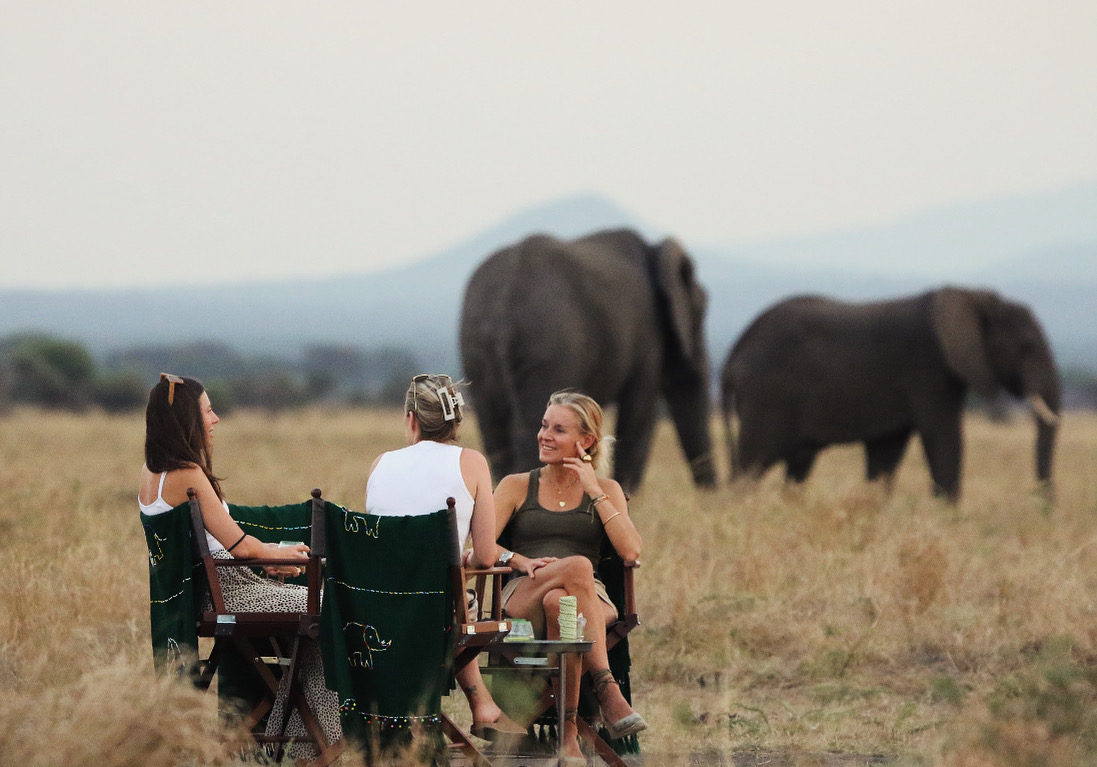
An interview with Karin Jones, CTC, MBA
Founder of Artisans of Safari
Designing African safaris since 1987
Host & Co-Producer of Safari ChangeMakers
Recognized by Travel + Leisure / Condé Nast Traveler
Safari Postcard: How Karin Jones is Designing Journeys Where Communities, Wildlife and Travelers All Win
Section 1 – Origins & Approach
Q1. You’ve been shaping safaris for more than two decades. How did Safari ChangeMakers begin, and what inspired your approach?
“Safari ChangeMakers” grew out of my almost four-decade career designing transformative journeys in Africa. I’ve always believed that tourism can fund conservation and communities, but I’ve also witnessed how it can fuel overtourism, environmental degradation and economic inequality. After the pandemic, travelers began searching for purposeful experiences, and it became clear that Africa’s future depended on genuinely regenerative models. I launched the Safari ChangeMakers video podcast to amplify African conservation leaders and social entrepreneurs who are creating community-owned conservancies, plastic-free programs and indigenous-led tourism.
The show features conversations with Africa’s visionaries—people like Praveen Moman of Volcanoes Safaris, whose work around gorilla lodges in Uganda and Rwanda channels tourism revenue into community projects and habitat protection; Simon Teede of Ele Collection, pioneering zero-waste solutions in Zimbabwe; and Matthew Saus of Manta Resort on Pemba Island, where the creation of marine protected areas and reef-guarding initiatives is directly tied to each guest stay. The show transcends mere storytelling—every episode connects directly to actionable travel that channels funds back to these projects. My approach is built on nearly four decades of relationships and intimate knowledge of Africa: understanding the nuances of each ecosystem, centering local voices and designing journeys that give back more than they take.
Q2. What makes your approach to safari different from traditional models of luxury travel?
Traditional luxury often equates “five star” with chandeliers and thread counts, but Artisans of Safari was founded on the belief that comfort and conscience must meet seamlessly. We guide guests off the grid to remote conservancies where vehicle numbers are deliberately capped and your visit directly supports local jobs, micro-enterprises, education and empowerment programs. I believe true luxury is the thrill of waking to elephant tracks pressed into the sand outside your tent and the warmth of gathering around a fire with storytellers whose roots run deep.
Another distinction is that I deliberately design itineraries with space for serendipity—time for unexpected moments to happen. Instead of racing from one lodge to the next, I build in generous breathing room so guests can linger three or four nights in each place, watch elephants from the veranda and have unplanned conversations with their hosts and local communities. Owner-operated lodges excel at this: at Ol Malo in Kenya’s Laikipia, the Francombe family might take you riding or walking along the escarpment before sunset drinks on a rocky outcrop; at Lewa Wilderness, you might spend a slow afternoon on the hillside with the Craigs, hearing how a family ranch evolved into one of East Africa’s great conservation stories; at Tanda Tula in South Africa’s Timbavati, lingering in camp as elephants drift past the waterhole often leads to fireside storytelling with the owner team about how they’re reimagining what inclusive, locally-led safari looks like.
Large operators sometimes try to replicate authenticity with scripted toasts and central menu templates, but authentic safari experiences cannot be staged. By favoring owner-led lodges where the hosts know each guest’s story and invest profits back into their communities, we restore soul to safari travel and ensure your stay benefits local people and landscapes.
Q3. After all these years, what continues to move you about the work you do?
What still moves me is witnessing travelers’ eyes light up when they experience Africa’s raw beauty for the first time, knowing that their journey is funding conservation and empowering communities. After decades in the bush, no luxury amenity can compete with that moment when a leopard emerges at dawn and pads silently through golden grass, or when a family realizes that the chorus they hear at night is a symphony of frogs, insects and distant lions rather than background noise to be shut out.
I’m also deeply moved by the relationships at the heart of this work. Lodge owners, guides, trackers and community leaders are not just business partners but long-standing friends and conservation allies. Many are second- or third-generation custodians of their land, holding stories that stretch far beyond any marketing brochure. Each trip I design is a way to honor those relationships by sending travelers who genuinely care, and by ensuring that the economic benefits of their journeys reach the people doing the hard work of protecting these places.
Q4. What was your first safari experience like — and how did it shape your life?
My first major expedition in 1989 took me through Botswana, South Africa and Zimbabwe—at a time when Nelson Mandela was still imprisoned on Robben Island, apartheid gripped South Africa and the Cold War was in its final chapters. Back then, luxury meant a hot water bottle in a canvas tent that sometimes leaked. There were no cell phones—we communicated via crackling radios and the occasional fax. I remember when we got our first fax machine and sent the first fax over to Africa—it was unbelievable to imagine that someone could read something I’d written just seconds after I sent it.
The experience was life-altering: I discovered vast landscapes where wildlife still moved to ancient rhythms and communities depended on fragile ecosystems. That journey made Africa my passion and livelihood and cemented my belief that travel, when done well, can be a force for good rather than extraction.
Q5. What drives you today — curiosity, conservation, or connection?
All three.
Curiosity keeps me exploring lesser-known corners of the continent—from remote salt pans and seasonal camps in Botswana to little-visited valleys in Rwanda and beyond.
Conservation is the ethical backbone of every itinerary we design; we only partner with lodges and guides whose work actively supports wildlife protection and community development.
Connection is perhaps the most powerful driver—connecting travelers to nature, to local cultures and to themselves.
My true craft isn’t about knowing every track in the bush—it’s about understanding people. Each client is a unique puzzle, and my job is to craft the safari that fits them like a perfectly tailored suit. Are they wildlife photographers chasing perfect golden-hour light? A multigenerational family wanting to create “remember when…” stories that will be told for decades? Wine enthusiasts hoping to pair their safari with cellar-door discoveries? I spend time understanding their travel style, family dynamics, hidden passions and unspoken fears, then design journeys that feel both deeply personal and profoundly place-based.
Section 2 – On Safari & Travel
Q1. For someone planning their first safari, what’s the best time of year to go?
Africa’s seasons vary by region. In Southern Africa (South Africa, Botswana, Zimbabwe and Zambia), the dry season from May to October offers excellent game viewing because vegetation is sparse and animals congregate around waterholes. Night temperatures can be cold but malaria risk is generally lowest. The summer “green” season (roughly December–March) brings lush landscapes, dramatic skies and many newborn animals.
In East Africa, game viewing is exceptional year-round. The major safari areas in Kenya and Tanzania are particularly rewarding from January–March and June–October. The famous wildebeest migration moves through Tanzania’s Serengeti from roughly January to September and Kenya’s Masai Mara from June to November. Gorilla trekking in Rwanda and Uganda is possible all year, but trails are usually easier in the drier months of June–September.
Q2. What destinations would you recommend for different kinds of travelers?
First-time safari goers:
The Serengeti/Masai Mara ecosystem or South Africa’s greater Kruger region offer iconic “Big Five” sightings and exceptional guiding. These areas balance comfortable logistics with a high density of wildlife, which is ideal for a first safari.
Families with young children:
Choose malaria-free reserves for peace of mind. South Africa offers outstanding options like Madikwe Game Reserve in the North West Province, the spectacular Tswalu Kalahari, and Eastern Cape reserves such as Kwandwe and Kariega. These offer Big Five viewing without anti-malarial medication, flexible activities and excellent child-focused programs. Kenya’s Laikipia region, while not malaria-free, is incredibly family-friendly—we can tailor experiences to your children’s interests, whether sculpting with termite clay, tracking wildlife by bike, visiting a local school or quad biking through the bush. Drawing on my own experience taking our now college-aged kids to Africa, I build itineraries that balance adventure with downtime. Near Nairobi, one magical family day might include a morning game drive in Nairobi National Park, a bush brunch, and an afternoon tucking orphaned elephant calves into bed at the Sheldrick Wildlife Trust.
Adventure seekers:
Head to Botswana’s Okavango Delta for mokoro (dugout canoe) safaris and to Zambia’s South Luangwa for some of Africa’s finest walking safaris. In both, I love using small, remote camps where you fall asleep to frogs and hippos rather than generators and traffic.
Wildlife photographers:
The predator-rich northern or eastern-central Serengeti outside peak migration season can offer long, unhurried sightings with very few other vehicles. You’re more likely to spend an hour with a single pride than to jostle for position in a crowd.
Culture & community enthusiasts:
Pair game viewing with time in community-driven conservancies and cultural landscapes. In Kenya’s Laikipia or Namibia’s Damaraland, for example, you can visit local villages, meet community rangers and see how wildlife coexist with livestock. For a historical layer, we might add time in Morocco’s medinas or Egypt’s ancient sites, including after-hours access to temples or private visits with local artisans.
Primate lovers:
Trek through the jungles of Rwanda and Uganda for encounters with mountain gorillas, chimps and golden monkeys. Our itineraries often include behind-the-scenes time with researchers at the Dian Fossey Gorilla Fund or a visit to the Ellen DeGeneres Campus to understand how your permit fees support long-term protection.
Desert & cultural explorers:
Venture to Namibia and Malawi to discover crystal-clear Lake Malawi and Namibia’s ancient red dunes and desert-adapted wildlife. Watch the Milky Way blaze across the night sky, explore Etosha National Park and the Skeleton Coast, and spend time with communities such as the Himba, learning how they’ve adapted to harsh environments.
Beach & island enthusiasts:
Combine safari with Indian Ocean bliss. You might hop between Seychelles’ granite islands, dive Mozambique’s reefs, or explore tropical forests in Mauritius. Madagascar adds an entirely different dimension—lemurs in the trees, chameleons in the undergrowth, and a culture unlike anywhere else on earth. These post-safari havens offer both barefoot relaxation and meaningful excursions.
Repeat travelers seeking new horizons:
Discover South Africa’s Great Karoo, a region that recently captivated me at every turn. At Ganora Farm, a homestead dating back to the mid-1700s, owner Jan-Peet curates a remarkable collection of fossils unearthed on the property from 280 million years ago, alongside beautifully preserved Khoikhoi and San rock paintings that animate 10,000 years of Bushman folklore. Afterwards, sit down to a traditional South African farm lunch with his wife Hester, whose stories bring Karoo life into focus. Nearby, the Valley of Desolation’s towering dolerite cliffs feel almost otherworldly. From there, continue on to Samara for wide-open landscapes, cheetah and rhino conservation and, if you like, an introduction to fly-fishing basics—bringing my career full circle from my very first tourism job in 1987 with a fly-fishing expedition company.
Or venture further afield to the peaceful Republic of the Congo, a protected wilderness hundreds of miles west of the more troubled Democratic Republic of the Congo. Straddling the Equator, the ROC is more than 60% forest—a tapestry of jungle, swamp, savanna, rivers and mineral-rich clearings called baïs. Here you can watch gorillas and monkeys move through the canopy, forest elephants and buffalo graze in open glades, and an astonishing array of birds and butterflies animate the air. A journey here deepens your understanding of the natural world and how intricately everything is connected.
Q3. How can travelers ensure their safari leaves a positive impact?
When choosing an operator, look for lodges that implement renewable energy, water conservation and waste-management programs, and that source locally and employ people from surrounding communities. Our philosophy at Artisans of Safari goes further: we steer guests to off-the-grid sanctuaries whose very reason for existing is conservation and community uplift.
At Wild Hill in Kenya’s Enonkishu Conservancy, for instance, co-founders Tippa and Tarquin Wood have transformed exhausted cattle land into regenerating wild habitat. The lodge runs on solar, harvests rainwater and avoids plastic bottles; guests might help harvest vegetables from the Wild Shamba organic garden for dinner or plant indigenous trees that reconnect wildlife corridors while providing shade and forage. In Zambia’s Lower Zambezi, camps like Chiawa have for decades coupled extraordinary canoe and river safaris with support for anti-poaching patrols and community projects. Across selected African Bush Camps properties in Zimbabwe and Botswana, solar power, careful water use and waste reduction are matched by long-term investment in guiding careers, schools and women’s enterprises.
We also follow clear wildlife-first protocols that keep animals comfortable and your experience consistent. Your guide will brief you on distance, time at sightings and positioning, and we avoid real-time geotags for sensitive species and locations.
Our Wildlife-First Guidelines:
- GIVE SPACE – Your guide will set appropriate distances.
- KEEP IT BRIEF – We rotate fairly at sightings so wildlife isn’t overwhelmed.
- LEAVE A PATH OPEN – No blocking routes or natural crossings.
- LOW NOISE, LOW LIGHT – No flash photography at night; no spotlighting sensitive species.
- POSTS AND TAGS – Share later, not live, and never geotag nests, dens, rhinos or carcasses.
When we move on from a sighting, it’s because the animal has asked for space. You will still get excellent viewing elsewhere, and we keep these places healthy for your next visit—and for the people and wildlife who live there year-round.
Beyond wildlife, we encourage responsible travel habits: learn about your destination, abide by park rules, walk only where permitted, and buy from local artisans. Avoid products made from coral, ivory or endangered species. Pack light, remove unnecessary packaging before you travel, use biodegradable toiletries and bring used batteries and electronics home for proper recycling.
Q4. What’s one misconception travelers often have about safari?
One common misconception is that all safaris are about “ticking off” the Big Five or witnessing the Great Migration. In reality, Africa’s magic lies in its diversity and its quieter moments. Predators don’t migrate, and some of the most rewarding game viewing happens away from the herds—in the northern or eastern-central Serengeti in February, for instance, I’ve had entire days with abundant resident wildlife and not another vehicle in sight, while peak migration months can mean traffic jams at key crossings.
Another myth is that safari means roughing it. Today there’s a full spectrum—from beautifully simple mobile camps to architecturally remarkable lodges with heated pools and exceptional cuisine. You might spend one night in a bedroll under the stars in Zambia or Zimbabwe, listening to lions in the distance, and the next in a design-forward camp with an outdoor shower and a wine cellar. At places like the Loisaba Conservancy, stargazing “star beds” on open decks let you sleep under the sky with just a mosquito net between you and the Milky Way. Luxury isn’t one set standard; it’s about choosing the level of comfort that allows you to feel most fully present in the wild.
Q5. How do you balance luxury and sustainability in modern safari design?
Balancing luxury and sustainability require thoughtful choices rather than compromise. Sustainable lodges integrate eco-friendly practices—solar power, waste reduction, rainwater harvesting and low-impact architecture—to minimize their footprint. They source local materials, celebrate regional cuisine and employ staff from nearby communities, ensuring that money circulates where it’s most needed. At Artisans of Safari, we view luxury and responsibility as inseparable.
We handpick owner-operated lodges and small camps that blend high-end comforts with rigorous environmental practices and strong community partnerships. Dulini, in South Africa’s Sabi Sand, is a good example: with a small number of suites rather than dozens of rooms, a growing proportion of its power from solar, long-tenured local staff and deep support for neighboring communities, it delivers exquisite comfort with a light footprint. Stays like this prove that you can have fine linens, extraordinary food and world-class guiding without sacrificing ecological integrity.
We also design itineraries with generous time in each location so guests can do more than “consume” game drives. That might mean joining a conservation briefing, visiting a local school or craft cooperative, or cooking with a lodge chef using ingredients sourced from nearby farms. Whether guests choose a beautifully designed lodge or a simple mobile camp, the experience should leave a lighter footprint while delivering real comfort and meaningful immersion.
Q6. For repeat travelers who’ve done the “classic safari,” what lesser-known experiences do you recommend?
For repeat travelers, I often suggest shifting from headline spectacles to depth and nuance.
In Tanzania, explore remote corners of the Serengeti—far from the busiest migration crossings—during January to April, when resident predators and plains game go about their lives with almost no vehicles in sight. The sightings may be quieter, but the sense of intimacy is extraordinary.
In South Africa, pair the Eastern Cape’s private reserves with the cultural landscapes of the Karoo. You might already have experienced the winelands and Cape Town; a next chapter could include the fossil beds and rock art of the Karoo, the restored architecture of towns like Graaff-Reinet and extended walking safaris looking for smaller, lesser-known species.
For community-owned conservancies, consider Kenya’s Lewa Wildlife Conservancy and Zimbabwe’s Gonarezhou. At Lewa House, you’ll share meals with owners Sophie and Calum MacFarlane, visit the bloodhound anti-poaching unit and see how your stay supports predator-proof bomas, rangers and education programs for surrounding communities. At Chilo Gorge Lodge, founded by Clive Stockil on the edge of Gonarezhou National Park, you’ll witness how the Mahenye community helped co-create the park’s protection plan and how tourism has revitalized cultural practices—from songs and language to ceremonies—that were once at risk of vanishing.
For those ready to slow the pace and stretch comfort zones, walking and canoe safaris are transformative. Zambia’s South Luangwa is the spiritual home of guided walking safaris, while Zimbabwe’s Mana Pools and the Lower Zambezi region offer water-based perspectives—gliding quietly past elephants at the river’s edge or watching carmine bee-eaters on sandy banks. Spend a night under canvas in simple fly camps in Zambia or Zimbabwe, where the luxury lies in deep silence and a sky full of stars.
If you’re drawn to true remoteness, we can weave in tiny, seasonal camps on hidden islands in Botswana’s Okavango Delta or along the Linyanti, where you arrive by light aircraft and might not see another camp for hours. And for a marine conservation finale, finish with a few nights at Miavana on Madagascar’s private Nosy Ankao archipelago, where your stay supports marine protected areas, reef restoration and turtle monitoring, alongside community projects on the mainland. It’s a powerful way to connect the dots between inland wildlife, coastal ecosystems and the communities stewarding them.
Section 3 – The Philosophy of the Wild
Q1. You’ve spoken before about the parallels between design and nature — how do you see that relationship?
Design and nature share fundamental principles: balance, rhythm and purpose. In the bush there is no wasted movement—every track, call and pattern has meaning. Similarly, a well-designed itinerary isn’t a checklist of sights; it’s a story with arcs, pauses and breath. I approach safari design almost like composing music: first I listen—to the traveler’s history, fears, dreams and energy—then weave landscapes, lodges and encounters into a composition that flows naturally.
Great design, like nature, is adaptive. It respects constraints—seasons, migrations, weather—and still leaves space for serendipity. I deliberately avoid over-programming so there’s room for unexpected moments: a spontaneous invitation to join your guide’s family for tea, time to sit with a basket weaver in a village, an unhurried afternoon in camp when a herd of elephants decides to feed right below your deck. Instead of building 60-room hotels, I champion small, owner-led camps where scale, sustainability and community benefit are considered from the start. When a place is designed around ecosystem health and human connection, everything from the lighting to the layout encourages presence rather than performance.
Q2. What lessons can travelers bring home from time spent in the wild?
Patience and presence.
Safari teaches you to slow down. Some of the most profound moments happen when you stop chasing and simply sit—a waterhole at dusk, a herd of impala relaxing after a storm, vultures circling in silence. One of my most memorable nights was spent quietly observing a hyena clan under the stars, no glamour, no rush—just time to really see how intelligent and social these misunderstood animals are. That kind of immersion rewires how you pay attention at home.
Interconnectedness.
Watching how predators, prey, insects, plants and people form intricate webs makes it impossible to see your life in isolation again. A change in rainfall patterns affects grasses, which affects grazers, which affects predators, which affects communities whose livelihoods depend on livestock and tourism. The same cause-and-effect plays out in our cities and suburbs; we’re just less tuned in to it.
Humility.
Standing a respectful distance from an elephant or lion reminds you that you are a visitor in a much older world. There’s a dignity in accepting that you’re not in control—that the vehicle stops where the guide says, that weather and wildlife don’t follow your timetable. Bringing that humility home can soften how we move through work, family and community.
Generosity and community.
Many African cultures embody ubuntu—the belief that “I am because we are.” Time with communities living alongside wildlife can show you models of resourcefulness, hospitality and mutual support that contrast sharply with individualistic cultures. Travelers often return inspired to build stronger communities, support local initiatives and ask, “How can my choices uplift others?” rather than “What’s in it for me?”
Q3. If you could distill the spirit of Africa into one word, what would it be?
Ubuntu. In Nguni languages it means “I am because we are.” It captures the interconnectedness of people, wildlife and landscapes and the sense that our wellbeing is tied to the wellbeing of others. It’s present when a guide shares a story that isn’t in any manual, when communities have real ownership in conservation, and when travelers recognize that their journey is part of a much larger story.
Q4. How do you see safari evolving in the next decade?
Safari will, I believe, move decisively from sustainability to regeneration. Travelers are already asking harder questions: Who owns this land? Who benefits economically? What’s the lodge’s footprint? The most compelling answer isn’t “We use metal straws,” but “We’re restoring habitat, regenerating soils, and communities have equity and decision-making power.”
Community-owned conservancies and indigenous-led tourism will become more visible and, I hope, more common. I’m already seeing this with Safari ChangeMakers guests like Jackson Looseyia and Dominic Nchoe—founders of Tangulia Mara, the Mara’s only 100% Maasai-owned lodge—and with Rob and Storm Mason at Kalepo Camp in Kenya’s Namunyak Conservancy, where Samburu culture and conservation are inseparable from the guest experience. Technology will continue to support conservation—drones, camera traps and AI helping monitor wildlife and reduce poaching—while electric safari vehicles, wildlife-friendly amber-spectrum lighting that’s gentler on animal eyes, and better carbon accounting push operators to rethink logistics.
Luxury will be measured less by opulence and more by access, authenticity and positive impact. Travelers will look for clear evidence that their stay funds real conservation outcomes and community benefits. Storytelling will extend the safari beyond the trip itself—through podcasts, short films, impact reports and return visits. And as climate patterns shift, both travelers and operators will need to be more flexible with timing, destination choices and infrastructure that can handle extremes while minimizing impact.
Q5. If safari teaches us presence, what does it teach us about creativity?
Being in the wild is one of the most powerful creative resets I know. When you’re unplugged, the noise drops away and your brain starts to make new connections. Watching the dappled camouflage of a leopard can inspire a designer’s color palette; the architecture of a termite mound can spark ideas about ventilation and cooling; the rhythm of migration can reshape how a writer thinks about pacing a story.
Safari gives you long stretches of “white space” on game drives, in camp between activities, even in the quiet before dawn. That’s when ideas sneak in—while you’re staring at a horizon, listening to birds, or chopping vegetables with a lodge chef using produce from a nearby farm. Many of my clients return home with unexpected clarity: a business challenge that suddenly feels solvable, a creative project they finally know how to start, a life decision that crystallizes after watching a storm roll in across the savanna. Presence opens the door; creativity walks right through it.