
F.A.Q

Frequently Asked Questions

The best time to visit Africa is typically during the dry season, from June to October, when wildlife viewing is at its peak due to animals gathering around water sources. However, the ideal timing varies by region, with East Africa’s dry season from June to September and Southern Africa’s from May to October.  Conversely, the wet season, from November to April, offers lush landscapes and fewer tourists, but wildlife viewing can be more challenging due to dense vegetation and dispersed animals. Ultimately, the best time to visit Africa depends on your preferences and the specific experiences you’re seeking.  For More: Where to Go Month By Month


Africa is generally a safe destination for travelers, and with a few sensible precautions you can explore both the cities and the bush with confidence.

On safari, safety is a top priority at all reputable lodges. Camps are designed with wildlife in mind, and your guides and rangers are highly trained professionals who know the bush intimately. You’ll be fully briefed on camp protocols upon arrival — such as not walking alone at night — and wildlife encounters around camp are part of the magic. You are always in experienced, capable hands.

In the cities, a bit of extra awareness goes a long way. Stick to well-traveled areas, avoid displaying expensive cameras or electronics openly, and use transport recommended by your lodge or tour operator. And when it comes to jewelry — leave the valuables at home. The lions won’t mind, and frankly, neither will you once you’re out in the wilderness!

As a general rule for the whole trip: travel light, stay aware, follow your guide’s advice, and you’ll have a safe and incredible experience from your first city stop to your last sunset game drive.

The Big Five refers to five iconic African animals: the lion, leopard, elephant, buffalo, and rhino,  The Big Five on safari is often a top priority for travelers due to their status as iconic symbols of Africa’s wildlife. 

However, it’s important to note that there’s much more to African wildlife than just these five species, and a successful safari experience isn’t solely determined by spotting them. Each animal plays a vital role in the ecosystem

The Great Migration is a massive movement of millions of animals across the Serengeti-Mara ecosystem in East Africa, primarily involving wildebeest, zebras, and antelopes. 

It occurs between Tanzania’s Serengeti National Park and Kenya’s Maasai Mara Reserve, with peak river crossings typically happening from July to September. Whether you see it depends on timing and location during your visit. We will discuss this during our planning meeting.  There are also other migrations in other parts of Africa

The ideal duration for your African adventure depends on your desired countries and regions. We suggest a minimum of nine to ten nights, but many clients opt for two weeks or more, considering flight time.  The average is twelve nights on the ground

We ensure efficient use of your time, arranging flights strategically to minimize airport stays. In remote areas, you may travel by light aircraft, offering a unique aerial view and makes even your transportation a part of your adventure.

Camouflage — always avoid. This is the one hard no. Many African countries (Zimbabwe, Zambia, Botswana, and others) legally prohibit civilians from wearing camouflage, and you can face fines or confiscation at the border. Leave it at home entirely.

Black and blue — situational. They’re not automatically banned, but both colors are known to strongly attract tsetse flies, which can transmit sleeping sickness. If your safari is in a tsetse-prone area (much of sub-Saharan Africa), these are genuinely worth avoiding. Black also absorbs heat, which is uncomfortable in 90°+ temperatures.

White — not forbidden, just impractical. It shows dust and red dirt almost immediately, and a bright white shirt can startle animals at close range. Cream or stone tones give you the same light feel without the downsides.

The safari palette is your friend — khaki, tan, olive, sage, stone, and earth browns. These tones blend into the savanna, don’t attract insects, and reflect heat better than dark colors. Most safari outfitters default to these for good reason.

Yes to pants — and it’s genuinely both reasons working together. Mornings and evenings in the bush can be much colder than people expect, even on the equator, and an open game vehicle moving at speed makes it feel even colder. Then there’s the physical reality of safari days: high vehicle steps, thorny undergrowth, tall grass brushing your legs on a bush walk — all of that adds up quickly on bare skin.

The zip-off convertible pant is the classic safari solution for good reason: you start the morning drive bundled up, and by midday when the heat is full on, you’re in shorts without having to go back to change.

The lodge sprays will cover you in your room and around camp, but the one place they won’t reach is the game vehicle — so having your own small bottle in your day bag is worth it for those long morning and evening drives when mosquitoes are most active.

The sweet spot for most safari-goers is 20–30% DEET or a 20% picaridin formula like Sawyer. Picaridin in particular has become very popular because it’s odorless, won’t eat through your watch strap or sunglasses frames, and is just as effective. If you’re heading somewhere with a higher malaria risk, you can step up to Ben’s 30 or even Repel 100 — but use the stronger stuff sparingly and keep it away from any gear.

The short version: bring USD and don’t stress about currency exchange — with one important exception.

For East Africa and most of Southern Africa, US dollars are universally accepted at camps, lodges, and for tipping. The only destination where you’ll need local currency is South Africa, where you should plan to exchange to Rand either before you leave or on arrival.

As for tipping amounts and exactly who to tip — that’s all handled for you. Your personalized Safari Cash Calculator is included in your Final Documents, which are delivered roughly a month before departure once final payment is made. It walks through every person you’ll want to tip, the suggested amount, and how to break it down. That gives you plenty of time to visit your bank and request small bills — $1s, $5s, $10s, and $20s — which is really important. You can’t make change in the bush, so arriving with the right denominations means you’re never caught short in the moment.

One thing worth knowing: some lodges will let you add gratuities to your room bill at checkout, which is convenient. But internet and wifi can go down in remote areas, card machines stop working, and that option disappears. Cash in hand is always your safety net.

The simple rule: one good pair of hiking shoes + one pair of sandals covers every situation on safari.

Sneakers will absolutely do the job for game drives and general camp use, but if your itinerary includes any bush walks — which it should, they’re incredible — hiking shoes are the better choice. The terrain is uneven, and a mid or high-cut shoe protects your ankles from rocks and roots while also closing that gap between your pants and the ground where insects like to find you.

Sandals are perfect for relaxing at the lodge pool or in your tent, but switch to closed-toe once the sun goes down when insects are most active.

On packing: keep it to two pairs. Bush flights between camps run on small charter planes with tight weight limits — typically around 15 kg total in a soft-sided bag. Two bulky pairs of shoes can eat into that budget quickly.

Safari lodge or camp age requirements vary by property, typically ranging from six to twelve years old. Generally, children must be over six for game drives, with some lodges not accepting those under 12. Exceptions exist, especially with private safaris. Inquire with us for details when planning your safari. Also take a look at the different levels

It all starts with a conversation. We love getting to know our clients to plan a journey that’s perfect for you. We’ll ask practical and out-of-the-box questions, then use your answers and our Africa expertise to create incredible itinerary options. Together, we’ll refine until it’s your dream safari.

Safari pricing varies depending on factors like the season, accommodation standard, and inclusions (like game drives or private guides). Our suggestion? Talk to us, the safari experts. Share your budget, timeframe, and wishlist, and we’ll leverage our expertise to craft the best-value safari for you. 

Take a look at the different levels we’ve created on the Journey Levels page:  RAW LUXURY – REFINED ELEGANCE – SAFARI ELITE

Time is of the essence when planning your African adventure. Popular destinations like Africa fill up fast, especially during peak seasons. Booking nine to twelve months ahead, especially for summer or school holidays, ensures a wide range of accommodation options. For larger groups, allow at least 12 months. But don’t fret if you’re planning last-minute; we excel at organizing rapid safaris in just days. Leave the details to us!

Absolutely!  Over 39 years, our founder and team have personally experienced the luxury, style, activities, food, and service of various lodges, just like our clients would. Only those that meet our rigorous standards make it onto our list of recommendations.

Depends if it is commercial flights or shared charters, or private charters and which country you are in.

For Shared charters: Soft-sided bags are required for any portion of your trip involving bush flights.
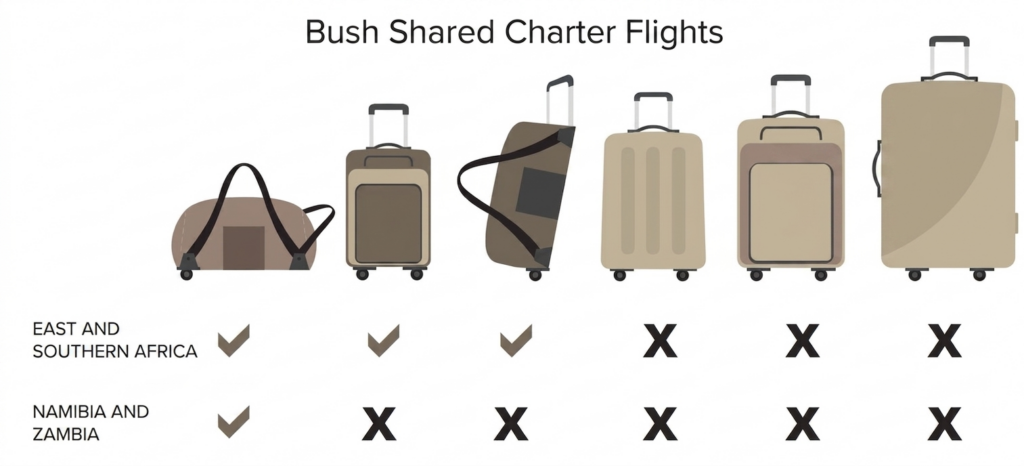

Charter planes have strict weight limits that vary by airline and route — typically between 15 kg / 33 lbs (most of East Africa, Zambia and Namibia) and 20 kg / 44 lbs (most of other parts of Southern Africa) — and bags must fit in a small cargo hold. Hard-shell suitcases simply won’t be accepted. A soft duffel plus a small daypack is the standard safari kit. If you’re adding a city stay (Cape Town, Nairobi), a hard case can live at the hotel while you’re in the bush. 

Note: Your own weight is typically required on our Guest form for these flights. 
Please note: In some cases, we can arrange for additional baggage weight to be purchased in advance for an extra cost. Please inquire.

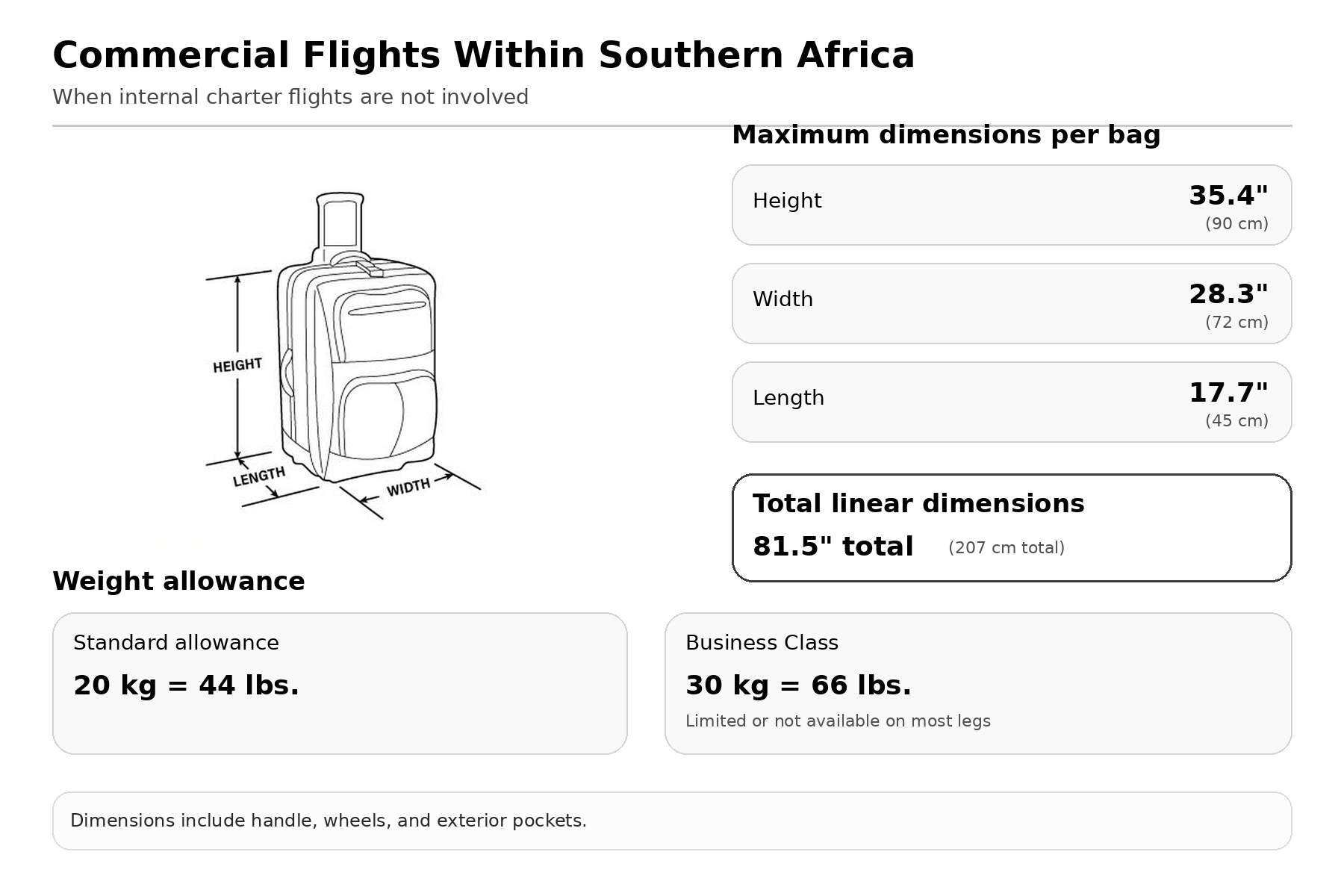
Note that Commercial Flights within Southern Africa Differ…However, if even one leg of your trip is on a shared charter, you should pack to the lower charter baggage limit and type of bags for the full safari, unless you are backtracking and have arranged storage for excess luggage.
Private Charters: We can discuss in more detail depending on the type and size of aircraft, number of passengers, and each person’s weight.

We have a full dedicated piece on this in your Guest Portal, which we set up for you once you’re booked.

The reputable camps we work with have first aid on site and strong relationships with regional medical facilities, but the most important protection is travel insurance that includes emergency medical evacuation coverage — this is essential, not optional. For clients traveling to Kenya and Tanzania, we enroll every client with AMREF Flying Doctors (African Medical and Research Foundation), which operates a dedicated air ambulance service across East Africa and can reach even the most remote camp. Between solid travel insurance and AMREF coverage, you’ll have a genuine safety net wherever your safari takes you.

The golden rule: see a travel medicine doctor 5–6 weeks before your trip. Vaccine requirements vary by country and by your personal health history, so there’s no universal list — but the one absolute is the yellow fever certificate for Rwanda and Uganda. That little yellow card lives with your passport for the entire trip. Some countries also check it on arrival if you’ve passed through a yellow fever zone, even briefly.

Everything else — hepatitis, typhoid, malaria prophylaxis, boosters — gets sorted in that doctor’s visit with your specific itinerary in hand.

Expect limited connectivity. Most camps offer some wifi in the main area, but it’s often slow and unreliable — intentionally so. This is a feature, not a bug. Most guests find the digital detox one of the highlights. Download anything you need offline (maps, e-books, playlists) before you arrive, and as noted with tipping, don’t count on wifi for anything time-sensitive.

Genuinely excellent — and most guests are pleasantly surprised. Safari camps take their dining seriously, with fresh local ingredients, creative menus, and a real sense of place. Breakfasts before the morning drive, bush lunches in the field, and candlelit dinners under the stars are all part of the experience. Dietary requirements — vegetarian, vegan, gluten-free, allergies — are accommodated without issue at virtually every reputable property. Just let us know when we’re planning your trip and we’ll make sure it’s noted across all your camps.

Yes — you can drink with confidence. All lodges supply safe, filtered drinking water and make their ice using that same filtered supply, so both are completely safe. Most lodges also provide a reusable water bottle for your stay.

One tip: For brushing your teeth, skip the tap — use the filtered water supplied by your lodge instead. This is the one small habit to keep in mind throughout your trip.

Absolutely yes. All lodge kitchens use the same filtered water for washing and preparing their fruits and vegetables, so everything served to you is clean and safe to eat.

In fact, fresh fruit is one of the real highlights of an African safari stay. Breakfasts are typically a feast of tropical and seasonal varieties — think papaya, mango, watermelon, pineapple, passion fruit, guava, and banana — beautifully arranged alongside a muesli station and a selection of yogurts. It’s a wonderful, fresh way to start a morning in the bush.

Salads and cooked vegetables are equally well-prepared and safe. Lodge kitchens take hygiene seriously, and guests can eat everything on the menu with complete peace of mind.

Most safaris are very accessible. Game drives are conducted from comfortable vehicles, so no fitness level is required for the core experience. Walking safaris, if offered, are typically gentle and guided at a relaxed pace. That said, some terrain can be uneven, and early morning starts are the norm — so good sleep and comfortable footwear go a long way.

Safari lodges today are far from roughing it. Most range from beautifully comfortable to genuinely luxurious, with en-suite bathrooms, real beds with quality linens, hot showers, and often a private deck or plunge pool overlooking the bush. Meals are a highlight too — fresh, generous, and often served under the stars or beside a fire.

That said, lodges are intentionally immersive — you may hear hippos at night, find a gecko on your wall, or wake to lions roaring in the distance. These are features, not flaws! Accommodation styles range from classic tented camps, which feel intimate and close to nature, to grand stone lodges with sweeping views. Whatever the style, expect to be well looked after — African hospitality is warm, genuine, and like nothing else in the world.

Safari lodges are remarkably well equipped to handle dietary needs of all kinds — vegetarian, vegan, gluten-free, nut allergies, and more. The key is to communicate your requirements clearly at the time of booking so the lodge kitchen can prepare accordingly. Don’t leave it until arrival — good lodges plan their menus in advance and source ingredients from afar, so advance notice makes a real difference.

Once on the ground, don’t be shy about reminding your host or waiter at each meal. Lodge staff genuinely want every guest to eat well and feel cared for, and in our experience the food — whatever your dietary needs — is consistently fresh, creative, and delicious. Eating well in the African bush is one of the great unexpected pleasures of a safari.